Food Service License in Tennessee: Which Permit You Need and How to Get It
A plain guide to the food service license in Tennessee: who needs a food service establishment permit, which agency issues it in Nashville, fees for temporary and farmers market permits, and when a different license applies.

In Tennessee, what most people call a “food service license” is a food service establishment permit. You need one to prepare food and serve it to the public, whether you run a restaurant, a catering kitchen, or a food truck. The permit comes from the Tennessee Department of Health, except in five large counties that run their own programs. In Nashville, that means the Metro Public Health Department.
Not every food business needs this permit. Stores, packaged-food makers, and home cooks selling under the Food Freedom Act follow different rules. This guide sorts out which one applies to you, then walks through getting it.
This guide is general information, not legal advice. Confirm your permit type with the health department before you sign a lease.
Key takeaways
- Restaurants, caterers, and food trucks need a food service establishment permit to serve food to the public.
- In Nashville, the Metro Public Health Department handles permits and inspections, not the state.
- The kitchen is inspected before the permit is issued, and permits expire every June 30.
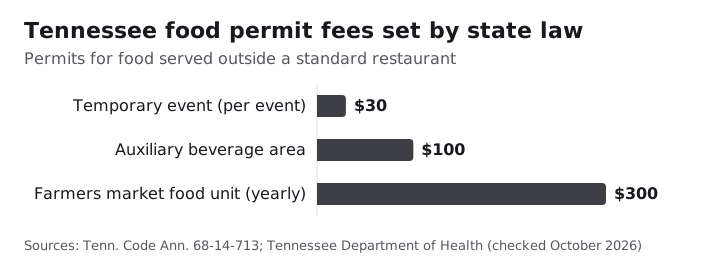
- Temporary event permits cost $30, and a Farmers Market Food Unit permit costs $300 a year.
- Packaged food and retail stores are licensed by the Tennessee Department of Agriculture instead.
Which License Do You Need?
Start here. The right license depends on what you do with the food.
| What your business does | License or permit | Who issues it |
|---|---|---|
| Prepares and serves food to the public (restaurant, caterer, food truck) | Food service establishment permit | Tennessee Department of Health, or your county in a contract county |
| Serves food at a one-time event | Temporary food service establishment permit | Same as above |
| Cooks and serves at farmers markets with temporary equipment | Farmers Market Food Unit permit | Tennessee Department of Health |
| Makes packaged food sold by others | Food manufacturer license | Tennessee Department of Agriculture |
| Runs a grocery or retail food store | Retail food store permit | Tennessee Department of Agriculture |
| Sells homemade food from a home kitchen | Usually none, under the Food Freedom Act | No license; labeling rules apply |
A food service establishment is any place “where food is prepared and the public is offered to be served or is served food.” That’s the wording of Tennessee’s Food Safety Act, and it covers places that are “permanent, temporary, seasonal or itinerant” (Tennessee Food Safety Act). It applies whether or not you charge for the food.
Making packaged meals for stores to resell? Our guide on how to start a meal prep business explains where food service ends and manufacturing begins. If you’re baking at home, start with our guide to Tennessee cottage food laws.
Who Issues the Permit in Nashville?
Tennessee’s Department of Health runs food service permitting for most of the state. Five counties, called contract counties, handle their own inspections, permits, and enforcement: Davidson, Hamilton, Knox, Madison, and Shelby (Tennessee Department of Health).
Nashville is in Davidson County, so your permit and inspections go through the Metro Public Health Department’s Food Protection Services, at 615-340-5620. Franklin and the rest of Williamson County are not contract counties, so businesses there work with the state program.
| Where your kitchen is | Who to call |
|---|---|
| Nashville and Davidson County | Metro Public Health Department, 615-340-5620 |
| Chattanooga and Hamilton County | 423-209-8110 |
| Knoxville and Knox County | 865-215-5200 |
| Memphis and Shelby County | 901-222-9190 |
| Most other counties, including Williamson | Tennessee Department of Health, 615-741-7206 |
How to Get a Food Service Establishment Permit
The order of steps matters. Building first and applying later is how new restaurants lose months.
1. Submit Plans Before You Build
Are you building, remodeling, or converting a space? Then the health department reviews your plans first, such as a scaled floor plan and equipment layout. Changes are cheap on paper and expensive after the plumbing is in.
In Nashville, you’ll also deal with Metro Codes for building and use permits. Start both conversations at the same time.
2. Apply for the Permit
The law says anyone who plans to run a food service establishment “shall first submit an application for a permit on forms provided by the commissioner.” The fee goes in with it. In Davidson County, you’ll apply through Metro Public Health.
3. Pass the Pre-Opening Inspection
The law requires an inspection before the permit is approved. The permit is issued only if the inspection shows the facility complies with the rules.
4. Display and Renew the Permit
- Permits expire June 30 each year and must be renewed.
- Permits can’t be transferred to another person or location. A new owner or a move means a new permit.
- The permit must be displayed where the public can see it.
What Does a Food Service Permit Cost?
Fees for standard restaurants are set by state law and based on seating. Ask your health department for the current amount for your seat count. Other permit types have flat fees:
| Permit | Fee |
|---|---|
| Temporary food service establishment | $30 |
| Auxiliary food service operation (a bar or beverage area tied to a restaurant) | $100 |
| Farmers Market Food Unit | $300 a year, or $150 if you apply after January 1 |
| Food manufacturer license (Department of Agriculture) | $50 to $750 a year, by size and risk |
The temporary and auxiliary fees come from section 68-14-713 of the Tennessee Food Safety Act. The Farmers Market Food Unit fee comes from the Tennessee Department of Health, and the manufacturer fees from the Tennessee Department of Agriculture.
Do You Need a Food Manager Certification?
Tennessee law asks each business to show demonstration of knowledge. Demonstration of knowledge is proof that the person in charge understands safe food handling. The Food Safety Act lists three ways to meet it:
- Passing an inspection with no priority item violations.
- Employing at least one certified food protection manager who passed an accredited exam.
- Answering food safety questions about your operation correctly during inspection.
A certified manager isn’t the only route, but it’s the most reliable one. For example, many restaurants and caterers keep a certified manager on staff. That way an inspection doesn’t hinge on one conversation.
Special Cases for Caterers
Caterers are food service establishments under Tennessee law, with one narrow exception. The law leaves out a caterer that meets all three of these tests:
- It has no regular full-time employees.
- It makes the food only in the owner’s own home.
- It makes only “occasional sales” in any 30-day period.
That exception is small. Once you hire staff, cater often, or cook outside your home, you need a permit. Ask the health department in writing if you think you qualify.
For regular catering, you’ll need a permitted kitchen. Many Nashville caterers rent time in a licensed commissary kitchen instead of building their own. Our guide to catering contracts covers the agreements you’ll want in place once you’re booking events.
Temporary Events and Farmers Markets
Festivals and one-time events. A temporary food service establishment is a food stand at a fixed spot during an organized event. Under state law, the event runs more than one day and no more than 14 days in a row. The permit costs $30. Event organizers usually collect vendor paperwork in advance, so ask early.
Farmers markets. If you cook and serve at a farmers market with temporary equipment, Tennessee offers a Farmers Market Food Unit permit. You’ll need handwashing setup, sanitizer, and temperature control at your booth. Our guide on how to sell at a farmers market covers the market side, including the Nashville Farmers’ Market’s insurance and booth fees.
Common Mistakes to Avoid
- Signing a lease before talking to the health department. Some spaces can’t be permitted without major work.
- Building before plan review. Equipment in the wrong place has to move.
- Assuming a shared kitchen’s permit covers you. Ask whether your business needs its own permit.
- Letting the permit lapse on June 30.
- Selling the business and the permit together. Permits don’t transfer.
Frequently Asked Questions
Do I need a food service license in Tennessee?
If you prepare food and serve it to the public, yes. Restaurants, caterers, and food trucks need a food service establishment permit. It comes from the state health department, or from the local one in contract counties like Davidson.
Who issues food service permits in Nashville?
The Metro Public Health Department’s Food Protection Services handles permits and inspections in Nashville and Davidson County. Call 615-340-5620.
How much is a food service permit in Tennessee?
Fees for standard restaurants are set by state law based on seating. A temporary event permit costs $30, and a Farmers Market Food Unit permit costs $300 a year.
Do caterers need a permit in Tennessee?
Most do. The only exception is a catering business with no regular full-time employees that cooks only in the owner’s home and makes only occasional sales. Regular caterers need a permitted kitchen.
Do Tennessee food service permits expire?
Yes. Permits expire on June 30 each year and must be renewed. They can’t be transferred to a new owner or location.
Is a food manager certification required in Tennessee?
Tennessee requires establishments to demonstrate food safety knowledge. Employing a certified food protection manager is one of three ways to meet that requirement.
The Bottom Line
For most Nashville food businesses that serve the public, the license you need is a food service establishment permit from Metro Public Health. Talk to them before you lease or build, pass the pre-opening inspection, and renew every June. Once your kitchen is permitted and orders come in, see how catering delivery and meal prep delivery work across Nashville and East Nashville, or price a delivery route.